
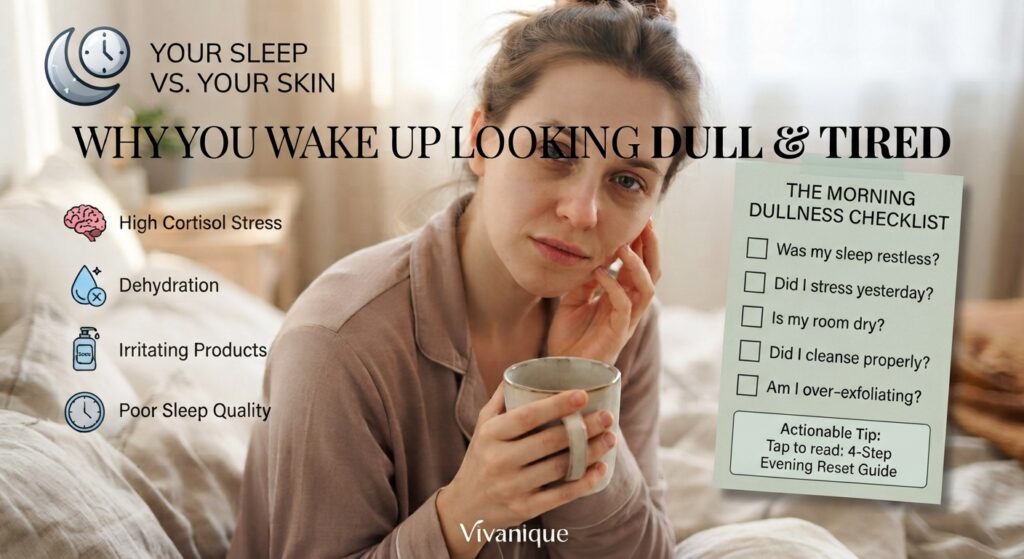
Sleep may be the missing piece when you wake up looking dull and tired, even after spending eight hours in bed. That does not necessarily mean your skin needs another expensive serum or a longer morning routine. Sometimes the bigger issue is what happened before your head reached the pillow: your sleep may have been restless, your skin may still have been carrying the day, or your evening routine may have been irritating rather than supporting it. Waking up with a tired-looking complexion can be frustrating. You may notice that your skin looks flat, dry, puffy, uneven, or less comfortable than it did the night before. One morning is not a diagnosis, and your face can look different for many ordinary reasons. However, if the pattern keeps returning, your nighttime habits are worth looking at more closely. Here are several possible reasons your skin may look tired in the morning and the simple evening changes that may help.
1. Eight hours in bed does not always mean restorative sleep
The number on the clock is only part of the sleep picture. You can spend eight hours in bed and still wake up exhausted if your sleep is interrupted, your bedtime changes constantly, your room is uncomfortable, or your mind stays active late into the night. Sleep deprivation and irregular sleep have been associated with changes in skin barrier function and other aspects of skin health. That does not mean one late night will ruin your complexion. It means that repeated poor-quality sleep may become one part of a wider pattern that affects how rested and comfortable you look and feel. Start with a realistic question: Was I asleep for eight hours, or was I trying to sleep for eight hours? If your sleep is often disrupted, focus on the basics before buying another product. Keep your wake time reasonably consistent, lower bright light in the evening, make your bedroom comfortable, and give yourself a few minutes to wind down. If you want to connect this idea to skincare, begin with a simple evening routine rather than adding several new products at once.
2. Stress can show up on your skin
A stressful day does not stay entirely in your thoughts. Stress can influence sleep, habits, inflammation, and the way you care for your skin. You may rush through cleansing, forget to moisturize, touch your face more often, or go to bed with makeup and sunscreen still on because you are simply worn out. Research has also linked psychological stress with changes in skin-barrier recovery. The relationship is not as simple as “cortisol destroys your skin overnight,” but ongoing stress can be one factor in a cycle of poor sleep, irritation, picking, breakouts, and inconsistent care. Vivian has explored this connection in How Stress Literally Changes Your Skin Texture. The useful takeaway is not to blame yourself for every change in your complexion. It is to notice whether your skin becomes rougher, more reactive, or more congested during periods when your stress and sleep are both worse. Try creating a small transition between work and bedtime. Dim one light. Put your phone away for a few minutes. Wash your face without rushing. A calming routine cannot remove every source of stress, but it can make the last part of your day feel less chaotic.
3. Your skin may still be carrying the day
By bedtime, your face may still have traces of sunscreen, makeup, sweat, oil, pollution, and whatever else it encountered during the day. Going to bed without cleansing can leave that buildup on the skin longer than necessary and may contribute to discomfort or clogged pores for some people. This does not mean your cleanser needs to leave your face squeaky or tight. Use lukewarm water, your fingertips, and a cleanser that suits your skin. If you wear makeup or water-resistant sunscreen, remove it thoroughly without scrubbing aggressively. If you prefer a more natural approach to removing makeup, you can also read 10 Natural, Easy and Healthy Ways to Remove Makeup. The central principle is the same: remove the day gently, then avoid turning cleansing into another source of irritation.
4. Your skin barrier may be uncomfortable
A healthy-looking complexion is not only about glow. It is also about comfort. If your skin feels tight, rough, flaky, itchy, or unusually sensitive when you wake up, your barrier may be struggling with dryness or irritation.
The skin barrier helps reduce water loss and protects the skin from external irritants. Hot water, harsh cleansers, frequent exfoliation, fragrance, dry weather, and too many strong products can all be difficult for some skin types to tolerate. If your face feels uncomfortable after your evening routine, do not respond by adding three more products. Start by reducing stimulation. A gentle cleanser and a moisturizer you already tolerate may be more appropriate than another exfoliating treatment. Vivian’s guide on how to fix a damaged skin barrier after over-exfoliating explains what to pause, how to return to basic care, and when professional advice is appropriate. Seek help from a qualified healthcare professional or dermatologist if you experience severe or persistent burning, swelling, hives, blistering, painful redness, infection-like symptoms, or worsening irritation.
5. Your routine may be doing too much
A crowded routine can look impressive on a bathroom shelf and still be difficult for your skin to tolerate. Layering several active ingredients does not automatically produce better results. It can make it harder to identify what is helping, what is irritating you, and what should be used less often.
A practical evening routine can be shorter: 1. Cleanse away the day gently. 2. Choose one treatment only if it matches your concern and your skin’s current tolerance. 3. Moisturize with a product your skin can use comfortably. 4. Rest and repeat instead of changing everything every few nights. You can explore 5 Skincare Ingredients I’m Obsessed With Right Now for ingredient context. The goal is not to collect every popular ingredient. It is to understand why a product is in your routine and whether your skin is comfortable using it.
6. Dehydration and your wider routine may be contributing
Skin can look less fresh when your wider routine is not supporting you. Not drinking enough fluid, spending time in dry air, taking long hot showers, eating irregularly, or feeling unwell can all affect how you feel and how your skin appears. These factors are not always the main cause, but they are worth considering alongside your products. Dryness can also be connected to the foods and habits you are considering. Vivian’s article on foods to limit if you have dry skin offers a broader conversation about skin health rather than promising that one food will transform your complexion. Avoid turning this into another set of strict rules. Drink regularly, eat balanced meals, and pay attention to patterns. If persistent dryness is accompanied by other symptoms, ask a healthcare professional for guidance instead of trying to diagnose the cause through social media.
A simple evening reset for tired-looking skin
If your skin looks dull in the morning, try this four-step reset for a few weeks rather than changing products every night.
Step 1: Cleanse gently
Remove makeup, sunscreen, sweat, oil, and daily buildup. Use lukewarm water and avoid rough cloths or aggressive rubbing.
Step 2: Choose one purposeful treatment
Pick one treatment that matches your main concern and follow its instructions. If your skin is stinging, peeling, or unusually dry, pause strong actives until it feels comfortable again.
Step 3: Moisturize for comfort
Use a moisturizer that your skin already tolerates. Ingredients such as ceramides, glycerin, petrolatum, and squalane appear in many barrier-supportive formulas, but the best choice is still the one that works comfortably for you.
Step 4: Make rest part of the routine
Wash off the day, put your phone away for a few minutes, keep your sleep environment comfortable, and repeat the routine consistently. You do not need a perfect night to make a supportive habit worthwhile.
What not to do when you wake up dull
Avoid panicking and immediately adding another exfoliating acid, scrub, retinoid, brightening serum, or home peel. Do not assume that tingling means a product is working. Do not try to “scrub away” dullness when your skin is already tight, hot, flaky, or sensitive.
Instead, observe the pattern. Ask whether your sleep has been disrupted, whether stress has been higher, whether your routine has become more aggressive, and whether your skin is comfortable after cleansing and moisturizing.
If you are also concerned about the way your skin changes during stressful periods, read 7 Anti-Aging Skincare Mistakes for a wider look at product-hopping, over-exfoliation, and everyday skin habits
Final thoughts
Waking up dull and tired after eight hours does not automatically mean you need more skincare. The quality of your sleep, your stress level, the products you use, your cleansing habits, and your skin’s current tolerance may all be part of the picture. Start with four steps: cleanse, choose one treatment when appropriate, moisturize, and rest. Then give the routine enough time to evaluate before you add something else. Healthy-looking skin is not built by chasing every new trend. It is supported by informed choices, comfortable products, consistent habits, and enough patience to notice what your skin is telling you. For another perspective on skin and whole-body wellbeing, explore Vivian Amadi’s wellness articles. You can also learn more about skin and nutrient conversations through 14 Best Vitamins for Flawless Glowing Skin and Hair. If you would like a simple version of this routine to keep beside your products, download The Evening Reset Guide through the signup form below this article and join the Vivanique community for practical skincare, beauty, and wellness updates.
Important: This article is for general education. It is not a diagnosis or individualized treatment plan. Persistent, painful, severe, or worsening skin symptoms should be assessed by a qualified healthcare professional or dermatologist.